




Murders happen every day across the globe, yet only certain cases leave a lasting imprint on the public consciousness. It is difficult to pinpoint the exact combination of factors that transforms a crime into a cultural obsession. Still, the Chrissie Venn Unsolved Murder Mystery is a compelling example of precisely that phenomenon.
The case had all the makings of a tragedy that would echo through the decades: a vulnerable young victim, a remote rural setting, a credible suspect who walked free, and a justice system that ultimately failed to deliver answers. Even more than a century after the events of 1921, the name Chrissie Venn continues to haunt the annals of Australian criminal history.
Unsolved Murder Mysteries like this one fascinate us not merely because of the macabre details, but because they force us to confront uncomfortable truths about the limits of law, the reliability of witnesses, and the fragility of justice. The story of Chrissie Venn is not simply a historical curiosity; it is a window into a world where a killer may have escaped accountability entirely, leaving behind a community scarred by grief, suspicion, and unanswered questions.
Who Was Chrissie Venn? Background on the Young Victim
Chrissie Venn was a 13-year-old girl living in the small, tight-knit community near the village of North Motton in Tasmania, Australia. In the early twentieth century, Tasmania was largely a rural society. North Motton itself was a quiet settlement where neighbors knew one another, and children were generally considered safe roaming the local roads on simple errands. Chrissie was no different from countless other young girls of her era. She lived with her family on Allison Road and carried out routine daily tasks.
On February 20, 1921, Chrissie left her home to run errands in the village. It was a simple, ordinary task, the kind of journey she had likely undertaken many times before. But she never returned home. Her disappearance set off a frantic search by the local community, and the anxiety that gripped North Motton in the days that followed would soon give way to devastating grief. Understanding who Chrissie was as a child, an innocent errand-runner, a daughter, is essential to appreciating the full weight of the tragedy that the Chrissie Venn Unsolved Murder Mystery represents.
The Discovery of the Body: How the Case Began
On March 1, 1921, the body of 13-year-old Chrissie Venn was found in a hollow tree stump near the village of North Motton in Tasmania. The discovery came nine days after Chrissie had set off on her errand and failed to return home. The location of her body, concealed within a hollow tree stump in a rural, wooded area, immediately raised alarming questions about the nature of her death and whether someone familiar with the local terrain had deliberately hidden her remains.
The discovery sent shockwaves through the small community and quickly attracted the attention of the Tasmanian press. Within days, the case had become a major news story, and the public was demanding answers. How had a 13-year-old girl come to die alone in the Tasmanian countryside? Who had placed her body inside a hollow tree stump? And why had it taken nearly two weeks for her to be found? These questions would form the backbone of the investigation that followed, and they remain partially unanswered to this day, cementing the case’s place among Australia’s most notable unsolved crimes.
Conflicting Reports in the Press: The Early Confusion
One of the more troubling aspects of the Chrissie Venn Unsolved Murder Mystery is the degree to which initial media reporting contradicted itself, sowing confusion about basic facts that should have been established quickly. After the discovery of her body, newspapers gave conflicting reports regarding even the most fundamental details of the case. They initially stated that Chrissie was murdered on February 21, the day after she disappeared, and that her body had been mutilated. These were explosive claims that stoked public outrage and fear.
Later, however, the date of death was revised to February 26, and the nature of the injuries was also reconsidered. Subsequent reporting indicated that Chrissie had been strangled or suffocated and that her body featured only defensive wounds, rather than the broader mutilation initially described. This kind of inconsistency in early reporting is not unusual in cases from that era, when journalism was less regulated, and sources were often unreliable. Nevertheless, the conflicting accounts made it harder to establish a clear timeline and undermined the evidentiary foundation that investigators needed to build a successful prosecution.
From a modern investigative standpoint, the discrepancy between an estimated date of death of February 21 versus February 26 is highly significant. A five-day difference affects the pool of viable suspects, the credibility of witness accounts, and the reliability of any alibis offered. It also raises questions about the quality of the forensic examination conducted on Chrissie’s remains and whether the standards of the day were adequate to support a criminal conviction.
George William King: The Prime Suspect
Public suspicion swiftly coalesced around one man: George William King, a 35-year-old former miner and policeman living in the North Motton area. The fact that King had previously served as a policeman made his alleged involvement in the murder particularly unsettling to the community. Someone who had once been entrusted with upholding the law was now accused of one of its most grievous violations. He was charged with the murder of Chrissie Venn, and for a time, it seemed as though justice might be within reach.
The circumstantial case against George William King rested on several key pieces of evidence. He had been seen in the area where Chrissie disappeared around the same time she went missing, placing him in close geographic and temporal proximity to the crime. Additionally, multiple people noted that King had a pattern of trying to engage Chrissie in conversation whenever they met, even though the girl typically tried to dismiss him and move on.
This behavior, described by witnesses as persistent and unwanted, suggested to investigators and the community alike that King had an unhealthy fixation on the young girl.
Perhaps most damning was the physical evidence on King’s person. During the examination, investigators noted scratches and marks on his hands. King explained that he had sustained these injuries while participating in the search party organized to find Chrissie while she was still listed as missing. While the explanation was plausible on the surface, it was also exactly the kind of alibi that a calculating individual might construct, one that could not be easily disproved and that conveniently explained away potentially incriminating physical evidence.
The Anonymous Letter: A Key Piece of Evidence in the Investigation
Among the most intriguing elements of the Chrissie Venn Unsolved Murder Mystery is the discovery of an anonymous letter found during a police search of George William King’s home. The letter was addressed to King, and its contents were extraordinary: the anonymous author claimed to have personally witnessed King commit the murder of Chrissie Venn and urged him in urgent terms to confess to the crime. The existence of the letter suggested that at least one person in the community believed they knew exactly what had happened to Chrissie and that person believed King was responsible.
Despite the dramatic nature of the letter’s claims, the anonymous writer never came forward as a witness. The decision not to identify themselves is understandable in some respects; coming forward to testify against a former police officer in a rural community could have had serious social and personal consequences, but it was legally devastating. Without a witness willing to take the stand and affirm the letter’s allegations, the document became merely circumstantial evidence rather than a cornerstone of the prosecution’s case. The anonymous letter remains one of the most tantalizing aspects of the Chrissie Venn cold case, suggesting that the truth may have been known to someone who chose, for whatever reason, to remain silent.
The Trial of George William King: Justice Sought and Justice Denied
The trial of George William King for the murder of Chrissie Venn was one of the most closely watched legal proceedings in Tasmania at the time. At trial, King was represented by Albert Ogilvie, a skilled and ambitious lawyer who would later become the Premier of Tasmania. Ogilvie’s involvement in the case is historically noteworthy; it demonstrates that King had access to legal representation of the highest caliber, which proved a decisive factor in the trial’s outcome.
Albert Ogilvie mounted a defense centered on attacking the credibility of the witnesses who had provided circumstantial evidence against his client. He systematically demonstrated that individuals who had placed King near the scene or described his behavior toward Chrissie were not entirely reliable narrators. Their testimony contained inconsistencies, their recollections were uncertain, and their motivations could be questioned. In a trial that depended entirely on circumstantial evidence, with no confession, no definitive forensic proof, and no eyewitness testimony that could withstand cross-examination, Ogilvie’s strategy was devastatingly effective.
Ogilvie secured a not guilty verdict for George William King by proving that the witnesses who gave circumstantial evidence against him were not sufficiently reliable to support a conviction beyond a reasonable doubt. King walked free. For the community of North Motton, for Chrissie’s family, and for all those who had followed the case, the verdict was a profound shock. A child had been murdered, a man had been charged, and the legal system had returned an acquittal. The case was effectively closed without resolution, leaving behind a wound that would never fully heal.
Albert Ogilvie: The Defense Lawyer Who Became Premier of Tasmania
The role of Albert Ogilvie in the Chrissie Venn murder trial adds a fascinating historical dimension to an already compelling case. Ogilvie was a prominent figure in Tasmanian legal and political circles, and his defense of George William King represents one of his earlier major courtroom victories. His ability to dismantle the prosecution’s circumstantial case speaks to his formidable legal talents, which would later serve him well in the political arena.
Albert Ogilvie served as Premier of Tasmania from 1934 to 1939, leading the Australian Labor Party to significant electoral victories and overseeing a period of progressive reform in the state. His legacy as a statesman has largely overshadowed his earlier legal career, but his involvement in the Chrissie Venn case is an important and often overlooked chapter in his biography. The fact that a future premier of Tasmania defended the prime suspect in one of the state’s most notorious unsolved murders is, to put it mildly, a remarkable historical footnote.
Why the Chrissie Venn Cold Case Remains Unsolved Over 100 Years Later
Chrissie Venn’s murder remains unsolved more than a century after her death. The reasons for this are multiple and interconnected. First and most fundamentally, the legal system of 1921 Tasmania was not equipped to handle the forensic demands of a murder investigation with the rigor we would expect today. There was no DNA analysis, no sophisticated toxicology, and a limited understanding of how to preserve and interpret physical evidence from a crime scene. The conflicting initial reports about the date and nature of Chrissie’s death suggest that even the basic post-mortem examination was conducted under conditions that would be considered inadequate by modern standards.
Second, the reliance on circumstantial witness testimony is always a fragile foundation for a murder conviction, which proved fatal to the prosecution’s case. When those witnesses were subjected to skilled cross-examination by Albert Ogilvie, their credibility collapsed. The anonymous letter, potentially the most significant piece of evidence pointing to King’s guilt, was rendered useless because its author refused to come forward. Whether through fear, social pressure, or some other motivation, the individual who may have held the key to the case chose silence over justice.
Third, the acquittal of George William King effectively ended any further official investigation. Once a person has been tried and acquitted, the principle of double jeopardy in legal systems of the British tradition generally prevents them from being tried again for the same crime. With King free and no other credible suspects identified, the case entered the long limbo of cold cases, technically unsolved, practically forgotten by the authorities, and kept alive only by local memory and occasional historical interest.
The Legacy of the Chrissie Venn Unsolved Murder Mystery in Australian History
The Chrissie Venn Unsolved Murder Mystery occupies a unique place in the broader history of Australian true crime. It is a case that encapsulates many of the systemic failures that plagued early twentieth-century criminal justice: inadequate forensic capacity, unreliable witness management, the disproportionate influence of skilled legal representation, and an investigative culture that struggled to build airtight cases against well-connected or resourceful defendants. George William King’s acquittal was not the last time that Australian courts would fail to deliver justice in a high-profile murder case, but the Chrissie Venn case stands as one of the earliest and most striking examples.
From a historical perspective, the case also sheds light on the vulnerability of children in rural Australian communities during the early twentieth century. The fact that a 13-year-old girl could be sent on errands alone, disappear without immediate alarm, and then remain missing for more than a week before her body was discovered speaks to both the isolation of rural life and the limited protective infrastructure available to children at the time. Chrissie Venn was failed not only by whoever took her life but by the broader social and institutional systems that should have protected her and then delivered justice on her behalf.
The case has also been referenced in discussions of Murder Mysteries from Australia’s colonial and post-colonial era, where it stands alongside other unsolved cases as evidence of how often the historical record conceals as much as it reveals. The passage of time has closed many avenues that might once have led to the truth. Still, it has also created new ones — archival research, forensic historical analysis, and renewed public interest in cold cases have all contributed to keeping Chrissie Venn’s memory alive.
Could Modern Forensic Science Solve the Chrissie Venn Case Today?
One of the most compelling questions raised by the Chrissie Venn Unsolved Murder Mystery is whether modern forensic science could succeed where 1921 investigators failed. The advances in DNA analysis, digital forensic reconstruction, and cold case investigation techniques over the past several decades have led to the resolution of numerous historical murders that once seemed permanently beyond reach.
In theory, if physical evidence from Chrissie’s case had been preserved biological material, clothing fibers, soil samples from the hollow tree stump, modern forensic laboratories could extract information that would have been completely inaccessible to investigators in 1921.
In practice, however, the prospects for new forensic breakthroughs in the Chrissie Venn case are limited. The likelihood that physical evidence from 1921 has survived in a condition suitable for analysis after more than a century is extremely low. The chain of custody for any such evidence, assuming it was ever formally catalogued and preserved, would be nearly impossible to establish to the satisfaction of a modern court. George William King himself died long ago, as did any witnesses who were alive in 1921. The case, in all probability, will never be formally resolved.
The Enduring Mystery of What Happened to Chrissie Venn
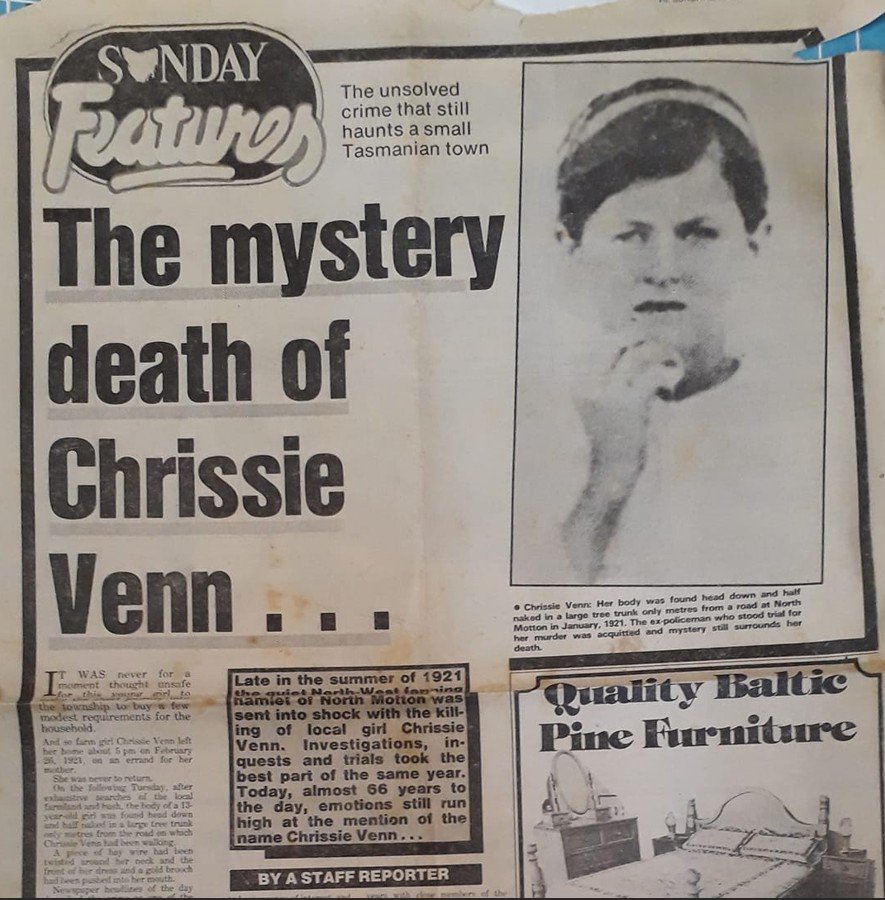
The Chrissie Venn Unsolved Murder Mystery endures not because it is sensational, but because it is deeply human. At its core, it is the story of a child who went out on an ordinary afternoon and never came home and of a community and a justice system that tried, and ultimately failed, to find out why. George William King stood trial, was defended by a future premier of Tasmania, and walked free on the strength of a not guilty verdict. The anonymous letter writer who claimed to have witnessed the murder never identified themselves. Chrissie’s family was left without justice or closure.
More than one hundred years after the discovery of her body in a hollow tree stump near North Motton, Tasmania, Chrissie Venn’s murder remains unsolved. The case is a sobering reminder that not every crime finds its resolution, that not every killer is held accountable, and that the pursuit of justice, however determined and sincere, does not always succeed. For those who study unsolved murders, cold cases, and the history of Australian crime, the Chrissie Venn case will continue to stand as one of the most haunting and unresolved chapters in the nation’s legal history.
What truly happened on that rural Tasmanian road in February 1921 may never be known with certainty. But Chrissie Venn deserves to be remembered not as a footnote, not merely as a data point in a discussion of unsolved crimes, but as a person whose life was cut short and whose story, for all its darkness, continues to speak to the profound human need for truth and justice.