



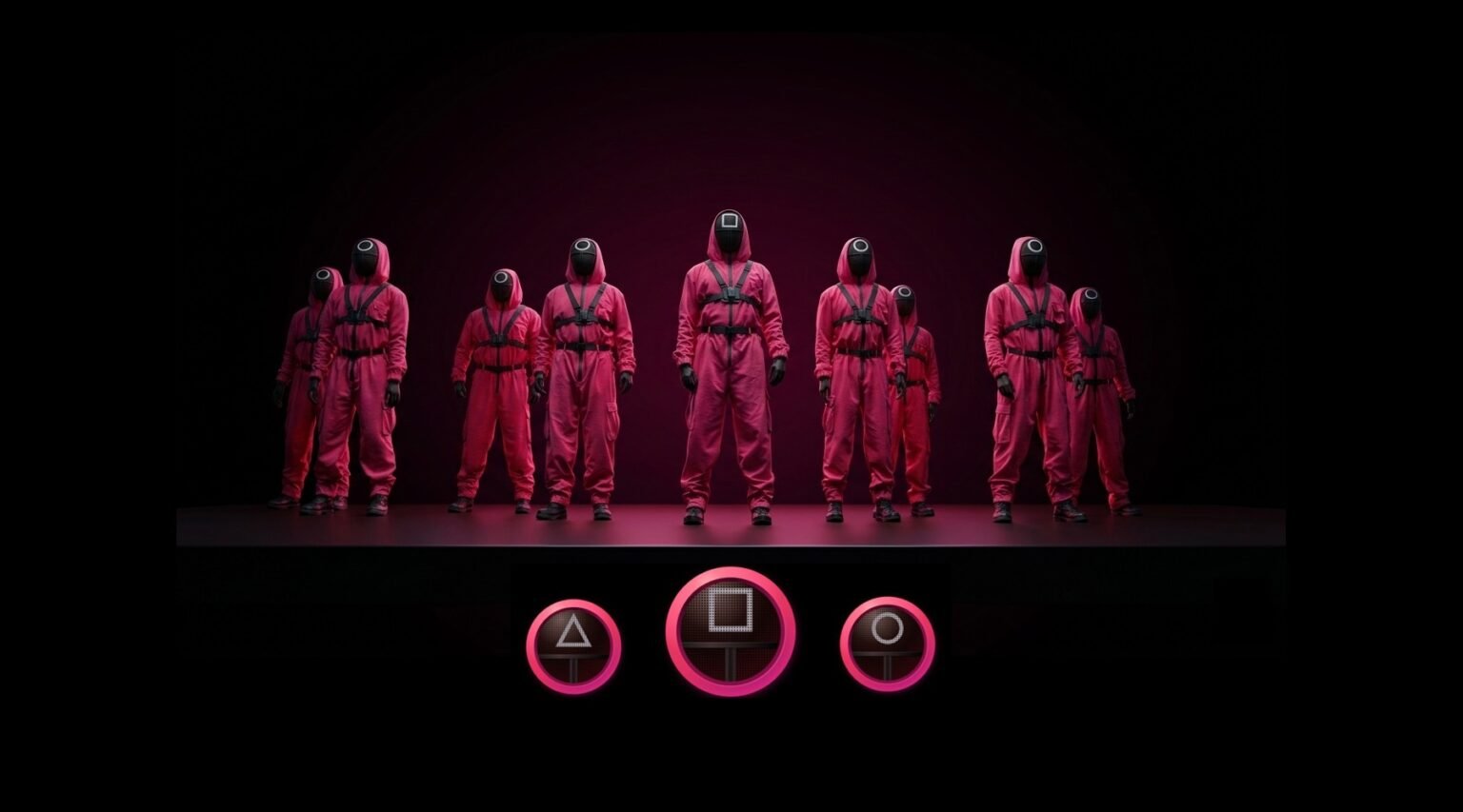
Death game movies and series place ordinary people, usually desperate, indebted, or marginalized, inside a constructed arena where they must compete, often to the death, under a rigid set of rules imposed by an unseen or powerful authority. The genre sits at the crossroads of thriller, social satire, and philosophical drama. It’s not new, but it has exploded into a global cultural phenomenon in the 2020s.
Why Filmmakers Are Drawn to This Genre
The surge in death game cinema is not accidental. It is a deliberate, creative, and commercial response to a world saturated with economic anxiety, algorithmic surveillance, and the quiet erosion of social trust. Filmmakers, particularly in East Asia, have found in the death game format a vessel that carries enormous cultural weight.
| South Korea · 2021 Squid Game Netflix Series Class warfare | Japan · 2020 Alice in Borderland Netflix Series Survival instinct | South Korea · 2023 Unlocked Netflix Film Digital danger |
| South Korea · 2017 Lucid Dream Netflix Film Psychological | South Korea · 2021 The 8th Night Netflix Film Supernatural | South Korea · 2023 Wall to Wall Thriller Betrayal |
At its core, the death game movies genre strips society down to its skeleton. When characters are forced to kill or be killed in rigged games invented by the ultra-wealthy, the screen becomes a mirror. The audience does not just watch strangers die; they watch an exaggerated version of the systems they already live within. Dong Hyuk Hwang, creator of Squid Game, spent nearly a decade trying to get his script made because studios considered it “too unrealistic.” The world caught up to the fiction.
Economically, these Death game movies are low-risk, high-reward for streaming platforms. A contained location, an unknown cast, and a high-concept premise require far less budget than a superhero blockbuster. Yet, they generate outsized engagement because the tension is relentless and episodes end on punishing cliffhangers. Netflix’s bet on Korean content proved that cultural authenticity, not Hollywood gloss, drives global viewership.
“The death game is capitalism distilled to its most honest form: everyone competes, the rules are rigged, and the house always wins.”
The Deeper Reasons: What Drives the Obsession
Economic despair as fuel. South Korea’s youth unemployment crisis, Japan’s karoshi (death by overwork) culture, and the post-2008 global anxiety about debt and inequality have created a generation that feels trapped. Death game stories give that feeling a concrete shape. The characters in Squid Game are not victims of bad luck; they are victims of a system that has already eaten them alive before the games begin.
The collapse of trust.
These films obsess over who can be trusted when survival is at stake. Alliance-building, betrayal, and the moment someone chooses self-preservation over loyalty are the genre’s emotional engine. Post-pandemic audiences, who lived through real social fractures, find these dynamics viscerally familiar.
Voyeurism and moral distance.
The death game format gives the audience permission to watch extreme violence by framing it as “what would you do?” The viewer is placed in a morally superior position outside the game, judging the players, which creates the illicit pleasure of spectacle without the guilt of endorsing it.
Streaming’s appetite for shock.
In an attention economy, content must compete with every other claim on a viewer’s time. Death, tension, and moral ambiguity are the most reliable tools for retention. The algorithmic logic of streaming platforms rewards shows that people cannot stop watching, and nothing is harder to stop watching than someone running out of time to live.
Pros and Cons of Death Game Cinema
| What these films do well 1: Expose class inequality with visceral, immediate storytelling that academic writing cannot match 2: Create genuine moral complexity, characters are neither purely good nor evil, reflecting real human behavior under pressure 3: Amplify non-English language cinema to global audiences, breaking Hollywood’s stranglehold on global culture 4: Spark real public conversations about debt, exploitation, systemic unfairness, and survival ethics 5: Demonstrate that genre entertainment can carry serious social critique without sacrificing tension or entertainment value | Legitimate criticisms 1: Risk normalizing extreme violence as entertainment, desensitizing audiences to suffering over time 2: Many imitators strip the social critique and sell only the spectacle, hollow brutality without meaning 3: Can reinforce fatalism, the idea that systems are so rigged that individual resistance is pointless 4: Disproportionate impact on younger audiences who may internalize hyper-competitive, zero-sum worldviews 5: Streaming incentives push production speed over depth, producing technically polished but emotionally thin content |
The Logic Behind Death Game Movies
| 01 The Veil of Ignorance Players begin as equals in the game, stripped of titles and wealth. This mirrors philosopher John Rawls’s “veil of ignorance” a thought experiment about what rules a just society would choose if no one knew their place in it. | 02 Game Theory in Action Every round tests whether cooperation or defection is more rational. The Prisoner’s Dilemma plays out literally on screen trust is always vulnerable to betrayal, which is exactly how real economies function. | 03 The Rigged System Metaphor The wealthy “designers” of the games represent institutional power. The rules appear fair but are designed to produce winners and losers. This is not fantasy it is a direct metaphor for tax policy, labor markets, and inheritance. |
| 04 Moral Regression Under Pressure Characters who begin as decent people make progressively worse decisions. The logic asks: is morality a luxury of comfort? Under genuine survival pressure, do human beings inevitably become what they despise? | 05 The Spectator Problem The wealthy characters who watch the games for entertainment are mirrors of the audience watching the show. The genre implicates its own viewer you are the VIP in the glass box, entertained by the suffering you claim to oppose. | 06 Catharsis and Control For audiences with no economic or political power, watching a system fail, watching the oppressed resist, provides emotional release a safe space to feel rage and hope simultaneously without consequences. |
My Opinion: What This Genre Really Tells Us
The death game genre is not, at its best, about death. It is about the lives people are already living before the first game begins. The reason these films resonate globally, crossing language, culture, and geography, is that economic precarity has become the universal human condition of the 21st century.
When 456 contestants in Squid Game voluntarily return after the first lethal round, the horror is not the game. The horror is that the world outside the game was worse. That moment is the genre’s thesis statement: the cruelty of entertainment is nothing compared to the quiet cruelty of ordinary life under late capitalism.
The most sophisticated entries in this genre, Squid Game and Alice in Borderland, earn their violence because it serves the argument. The weakest entries, the imitators borrow the aesthetic without the ethics, delivering spectacle that dulls rather than sharpens the viewer’s moral sense.
Whether this genre is ultimately good or bad depends entirely on whether it is used to make people think or merely to make people watch. At its best, it is literature in motion. At its worst, it is the very thing it claims to critique: a game rigged to extract maximum engagement before discarding everyone involved.